
The Invisible Threat: Fighting Back Against B2B Agro-Fraud and Business Email Compromise (BEC)
1 day ago
6 min read
Business Email Compromise (BEC) has officially evolved into a multi-billion-dollar global crisis. B2B cybercriminals are no longer just seeking random credit card numbers or deploying system-crashing ransomware. Today, highly sophisticated syndicates are aggressively targeting international supply chains; and the global agricultural commodity sector sits squarely in their crosshairs.
At Organic Trade & Investments (OTI), we believe that transparency is the best defense. By sharing our firsthand experiences and the robust defensive frameworks we have put in place, we want to help other global exporters mitigate risks, protect their bottom lines, and secure their digital perimeters.
Behind the Inbox: Anatomy of Three Intercepted Scams
Lately, OTI's sales and trade desks have faced an intense uptick in targeted phishing attempts. These are not standard, poorly written spam emails. These are meticulously researched, highly believable B2B corporate impersonations.
In the months of August and September alone, our Export Department intercepted three separate "ghost buyers" attempting to orchestrate deep-level supply chain fraud:
The Fake "Patrick" (Identity Theft & Domain Spoofing): Reaching out via a newly created domain (asiamaxgroup.com), this sender impersonated a real, verifiable Singaporean commodity professional found on LinkedIn. The timing was perfectly coordinated—hitting our Ghanaian inboxes at 1:22 AM, which aligned exactly with the opening of the Singapore business day (9:22 AM). The goal? To extract standard FOB/CIF price sheets, harvest our official invoice templates, and initiate a fake contract scam.

The Spoofed "Niama" / The UK Market Lead: On September 14, 2026, at 11:10 AM, our Export Department flagged an inquiry allegedly coming from a profile spoofing Niama, using the registered and authentic company's domain. The email featured the subject line: “Re: Bulk shea butter supply enquiry - UK market (The Full Name of The Company).” This tactic heavily relies on leveraging the names of highly respected, high-profile African tech founders and investment managing partners to drop an exporter's guard during initial inquiries.
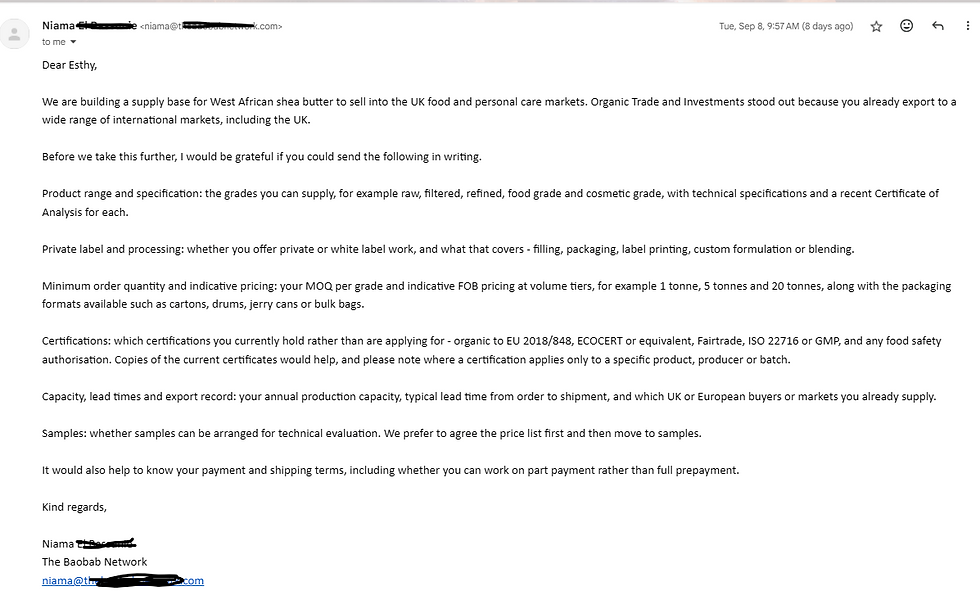
This email is exceptionally difficult to detect as a scam because it completely bypasses the typical "broken English" or generic templates of standard phishing, instead using flawless, highly technical industry vocabulary ("Certificate of Analysis," "EU 2018/848 organic certification," "FOB pricing at volume tiers") that perfectly mimics a highly sophisticated international buyer. Furthermore, by spoofing the real domain name (withheld for legal issues) of a highly respected, genuine African tech investor, using the CEO's actual name, passing standard TLS encryption, and specifically addressing OTI's leader by her name ("Dear Esthy"), the scammer establishes immediate, authentic trust that can easily slip past automated spam filters and busy sales desks alike.
In a separate blog post, we will demonstrate step-by-step how this scammer pulled this off behind the scenes using the technical clues from the victim's email log.
The Compliance Trap "Kevin Hughes": Utilizing the domain starservicesinternational.com, this persona utilized highly corporate letterheads and legal jargon to build immediate trust. The entire setup is a sophisticated trap designed to exploit OTI through a Fake Trade Credit Facility and Advance Fee scheme. By offering an enticing "credit insurance guarantee" and proactively volunteering a massive stack of corporate compliance documents, the scammer builds immediate psychological trust. The fatal flaw lies in the trade mechanics: once OTI falls for the bait and agrees to the massive order, the trap springs. The scammer will claim that a small, upfront "underwriting fee," "local registration tariff," or "legal activation cost" must be wired by OTI to release the multi-million-dollar credit insurance fund. Once that advance fee is paid, the fictitious "Kevin Hughes" will vanish completely, leaving the exporter with severe financial losses and an empty cargo schedule. This trap is designed to push the conversation toward "Advance Fee" mechanisms where the exporter is eventually asked to pay small upfront legal, registration, or port fees to secure a massive, fictitious multi-million-dollar contract.

This email is a highly calculated deception because the scammer is perfectly cloaking their identity behind a real, 41-year-old legitimate Australian corporation. The sender uses the exact, authentic physical headquarters in Mentone, Victoria, quotes their precise incorporation date, and relies on the company's real corporate email domain (@starservicesinternational.com) to pass baseline compliance checks. They even brilliantly leverage the company's actual, verified East African subsidiary operations to justify why an Australian chemical and material exporter is suddenly ordering massive shipping containers of cocoa powder to Mombasa Port.
Why is a Successful Brand Like OTI Targeted?
Scammers do not target random companies; they target successful, high-value entities. The frequency of these attacks is directly tied to OTI’s public triumphs:
High-Value Global Commodities: Organic shea butter and cocoa are liquid gold in global trade. A single bulk container contract can easily clear six figures, making the reward for a successful invoice interception incredibly high for a hacker.
Public Brand Prominence: OTI's visible growth—including our high-profile participation at major international trade launches like Alibaba.com in Ghana—has given us a highly visible SEO footprint. Scammers use automated scraping tools to scan international directories for high-growth, mid-sized global trading hubs.
Published Operational Capacity: Our massive 6,000 MT annual production capacity proves to international syndicates that OTI has the liquidity, infrastructure, and volume worth the effort of a manually crafted corporate lure.
A Global Pandemic: The Harsh Reality of B2B Agro-Fraud
Organic Trade and Investments is far from alone in this battle. According to the FBI’s Internet Crime Complaint Center (IC3), Business Email Compromise accounts for an astronomical $3 billion+ in annual reported losses.
The crisis has grown so severe that the US Department of Agriculture (USDA), the Food and Drug Administration (FDA), and the FBI have issued joint security alerts specifically warning the agricultural and food sector. Criminal networks are actively using lookalike domains to steal physical shipments of bulk ingredients, exploit commercial credit terms (like Net-30 or Net-60 agreements), and intercept legitimate cross-border wire transfers.
The OTI Shield: Our Mitigation and Defense Framework
Exporters can no longer safely manage bulk, multi-container orders via raw, unfiltered email boxes. To neutralize these threats, OTI has implemented a strict, gated operational protocol:
The Gated RFQ Wall: We completely cut off email-based pricing negotiations for unverified accounts. All new leads are forced to go through our secure, identity-verified Request for Quote (RFQ) system. This single step immediately filters out 99% of automated malicious scripts.
Domain Authentication Protocols: We have instituted rigorous email authentication controls—including SPF, DKIM, and DMARC configurations—to actively block external spoofed domains before they can touch our operations.
Strict Out-of-Band Verification: Any adjustments to banking details, shipment terms, or contract parameters require absolute, multi-channel verbal verification through independently sourced corporate phone lines—never through the numbers printed on an incoming email.
Crucial Operational Best Practices for Your Team:
Slow Down the Response Time: Do not rush to reply to first-time cold inquiries out of excitement for a potential sale. Scammers count on urgency and distraction. Take your time to run background security audits on every external sender domain first.
Even Loyal Customers Require Verification: If you receive a sudden request to change payment details, delivery terms, or standard ordering routines—even from a long-term, loyal customer—pause immediately. If you have any doubts, pick up the phone and call your client directly using the primary contact number on file.
Enforce Your Internal Control Processes: Never let a potential deal bypass your company’s established safety checks. Every employee, from junior sales rep to executive management, must adhere strictly to internal verification workflows before sharing sensitive corporate information, including technical specifications sheets, corporate certificates, warehouse and production facility pictures and videos, or invoicing templates.
Verify Personas Independently: When a sender claims to be a specific corporate professional, never use the telephone numbers, links, or contact info provided in their email signature to verify them. Instead, look them up independently on professional networks like LinkedIn. Reach out to them directly on their official social media pages or corporate switchboard to politely alert them that their identity is being spoofed.
In this era of hyper-connected global trade, vigilance is our most valuable asset. The technology that allows us to connect with authentic, incredible buyers worldwide is the exact same tool utilized by bad actors looking for a vulnerability.
My advice to fellow agribusiness leaders and exporters worldwide is simple: When a deal looks too good to be true, it means the deal is not true. Protect your processes, build high digital walls, and never sacrifice strict compliance for the illusion of a fast transaction."— CEO, Organic Trade & Investments (OTI)





Comments